Land Clearing Cost Per Acre, Straight
Published national figures put land clearing cost at roughly $500 to $5,600 per acre. That span is not vagueness — it is the honest spread between mowing down an acre of blackberry and felling, grubbing and hauling an acre of 80-foot oaks. Orient yourself inside it like this:
| What's standing on it | Typical per-acre range | What drives it |
|---|---|---|
| Light brush, saplings, overgrown field | $500–$2,000 | Machine time; a mulching day rate often beats per-acre land clearing |
| Mixed young woods, scattered mature trees | $2,000–$4,000 | Tree size, stump decision, debris plan |
| Dense mature hardwood, full grub & haul | $4,000–$5,600+ | Felling, grubbing, disposal weight, access |
Harford County specifics push land clearing within those bands: Piedmont slopes and rock slow machines north of Bel Air; tight suburban access matters in Bel Air South and Abingdon; open farm lanes up in Street and Whiteford make the same acre cheaper than its twin behind a townhouse.
The Four Questions That Explain Every Land Clearing Quote
- Stumps: cut, ground or grubbed? Leaving stumps is cheapest, grinding is cosmetic, grubbing (roots out) is mandatory under anything being built — and each is a different price.
- Debris: haul, grind, bury or burn? The single biggest swing. Hauling is clean and costly; mulching in place deletes disposal entirely; burial and burning are farm-country options with rules attached.
- Permits: whose job? Above 5,000 sq ft / 100 cu yd of disturbance, Harford County requires a grading permit with sediment control. A bid that ignores it is not lower — it is incomplete.
- Rock: priced or pretended away? Most of the county sits on Piedmont schist. Ask every bidder what happens at refusal and what the hourly hammer rate is.
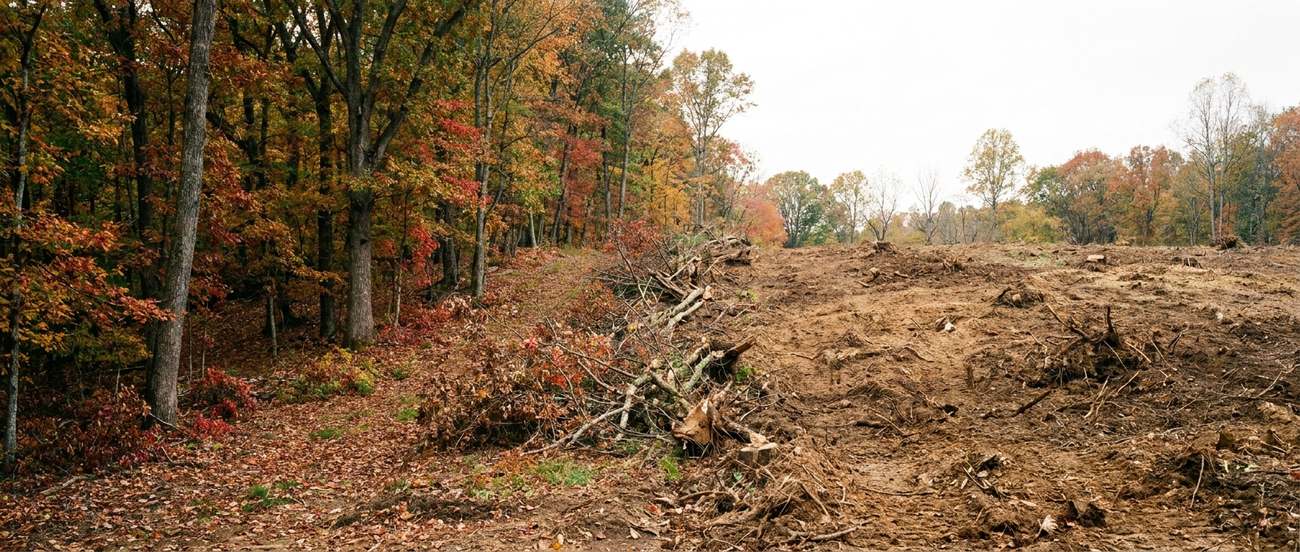
Land Clearing Methods: Mulching vs. Dozer vs. Haul-Off
Forestry mulching grinds brush and small trees where they stand — no piles, no hauling, topsoil intact. It is usually the value play for pasture reclamation, fence lines, trails and views, and it prices by machine time rather than per-acre theatrics. Dozer clearing with grubbing is what construction demands: roots out, organic soil stripped, ground ready for grading. Haul-off is a disposal choice layered on either. Most real Harford County projects mix them: grub the build footprint, mulch the rest — one mobilization, and the budget goes where the building goes.
Where the Extra Land Clearing Costs Hide
- Slope and access — hillside work and single-gate suburban lots add machine hours without adding acreage.
- Disposal distance — every loaded truck mile is on the bill somewhere.
- Forest Conservation — at 40,000 sq ft tied to a grading or building permit, the county's forest-conservation rules enter with review time and possible retention or planting obligations.
- Season — spring mud slows everything; the winter window on firm ground is the quiet discount in this trade.
When you want a real land clearing number instead of the range, the path is a site walk with the four questions answered in writing — which is exactly what a call to (443) 616-2889 starts.