What Comes Down Around Here
Harford County's building stock has age at both ends — postwar garages in Bel Air and Aberdeen reaching the end of sensible repair, and a farm belt where every property carries a barn, a silo base, a chicken house or a mobile home that stopped earning its footprint decades ago. Add the county's steady rebuild-in-place construction market and demolition becomes the quiet first chapter of most projects: the garage comes down so the bigger one can go up, the pool comes out so the yard comes back, the barn comes down before it chooses its own moment.
The Choreography Before the Machine
Demolition is mostly preparation. The permit gets pulled. Every utility touching the structure — electric, gas, water, sewer or septic — is verifiably disconnected. Miss Utility marks go down (3 full business days ahead, Maryland law) because yard lines run where memories say they don't. Anything hazardous is dealt with under the rules that govern it — and for pre-1980 structures that can include asbestos-containing materials, which Maryland requires licensed asbestos contractors to handle before general demolition proceeds. Then, and only then, the machine has its twenty loud minutes.
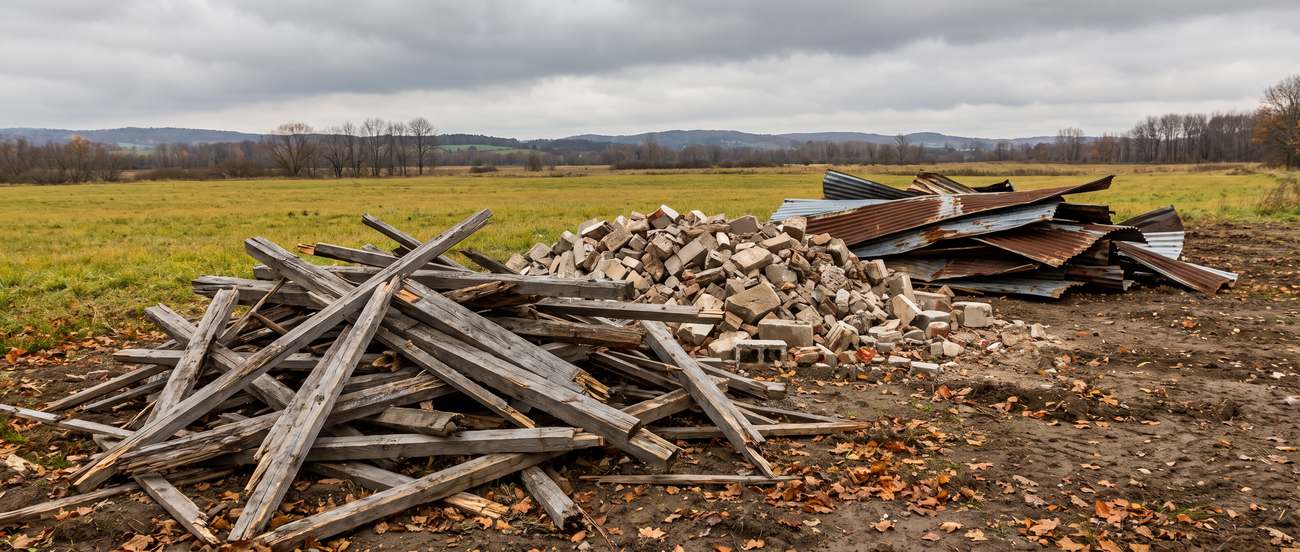
Slabs, Pools and the Hole Left Behind
What happens below grade is half the job. Slabs and footers get broken and hauled — or deliberately kept when the pad has a future as parking or patio base. In-ground pools are their own discipline: drained, walls broken for drainage, backfilled in compacted lifts so the lawn above never telegraphs the outline. Every void gets engineered fill, not just fill — a demolition that leaves a soft spot has simply converted your building problem into a grading problem.
Published Ranges, Real Variables
National ranges put sheds at $250–$3,000, detached garages at $2,000–$10,000, and mobile homes near $4 per square foot. Access moves the number (a tight Bel Air backyard versus an open farm lane), materials move it (block versus frame), and the slab decision moves it most. What should never move is the scope after signing — which is why the slab, the disposal stream and the finished grade are written into the quote before the first swing.