Farm Country Wants Ponds
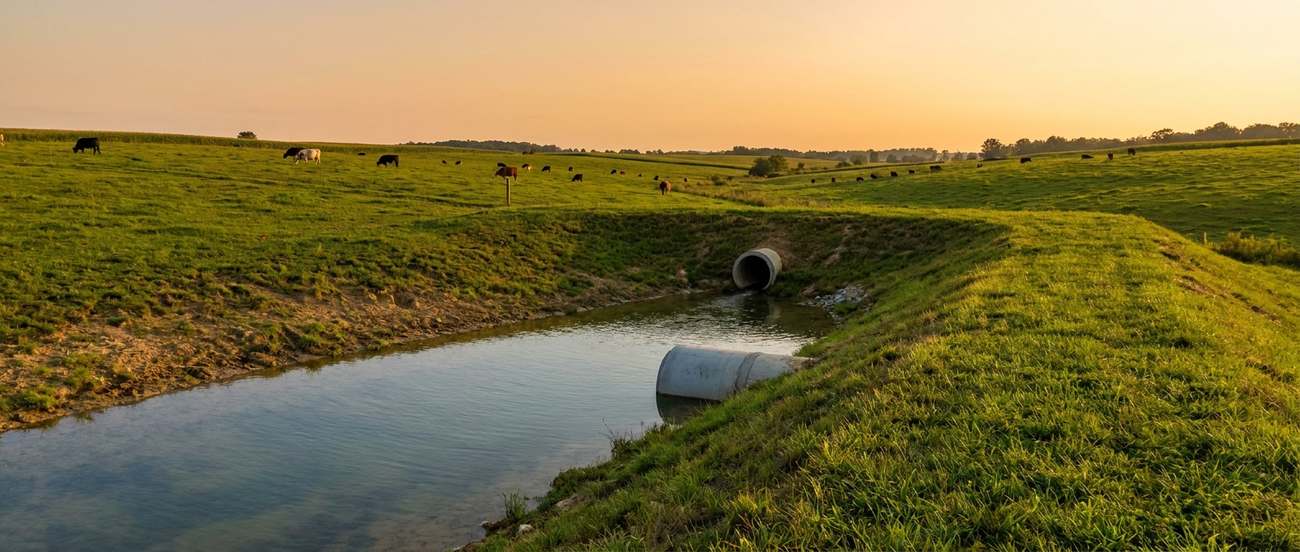
The northern half of Harford County — the big-parcel farm country around Jarrettsville, Street, Whiteford and Darlington — is pond territory by nature: rolling Piedmont ground, spring seeps, drainage ways gathering nearly 48 inches of annual precipitation off pasture and woodlot. A well-built pond up here waters livestock, feeds wildlife, holds fish, guards against fire and anchors the view for generations. A badly built one silts in, leaks through a sandy seam, or sends its embankment downstream in a tropical remnant. The difference is siting, soil and engineering — all decided before the first bucket.
Maryland's Small Pond Process, Demystified
Most constructed ponds in Maryland run through Small Pond Approval: plans prepared to the USDA-NRCS MD-378 standard and approved by the local Soil Conservation District, with MDE Dam Safety in the loop as embankment size grows. The standard covers what hard experience taught — spillway capacity, embankment compaction, outlet works — and the approval is the difference between an asset and a liability on your deed. We carry projects through it as a matter of course.
What Decides Whether Your Pond Works
- Soil. Clay-rich Piedmont subsoil compacts into a natural liner; sand seams and fractured rock leak. Test pits answer the question for hundreds of dollars, not tens of thousands.
- Water source. Springs and reliable drainage ways keep a pond alive; a pond fed by hope goes stagnant by August.
- Watershed size. Too little inflow and the pond shrinks; too much and storm flows demand serious spillway engineering. MD-378 exists precisely for this arithmetic.
- Depth. Real depth is what keeps summer temperatures down, weeds contained and fish alive — and it is much cheaper to dig on day one than to dredge in year ten.
Restoring the Pond You Already Have
The county is dotted with mid-century farm ponds two generations into their silt load — four feet of muck where eight feet of water used to be, cattails marching inward, the dock stranded. A cleanout excavates back to design depth, rebuilds edges, and hauls or spreads the spoil; embankment and outlet repairs bring the structure back to standard. It is the best money-per-result in pond work: the siting, watershed and approval already exist — you are buying back the original design.