Why Harford County Yards Hold Water
Nearly 48 inches of precipitation a year falls on ground that, across the Piedmont side of the county, is a couple of feet of workable loam over dense clayey subsoil over schist. Water enters that profile far faster than it leaves. The subdivisions built through the 1980s and 90s around Bel Air, Abingdon and Forest Hill managed it with builder-cut swales and positive grades — and thirty years of settling, fence posts, sheds and re-landscaping have quietly erased both. The result fills our phone every spring: lawns that squish into June, play sets on islands, mulch floating out of beds, and that one corner of the basement that smells like rain.
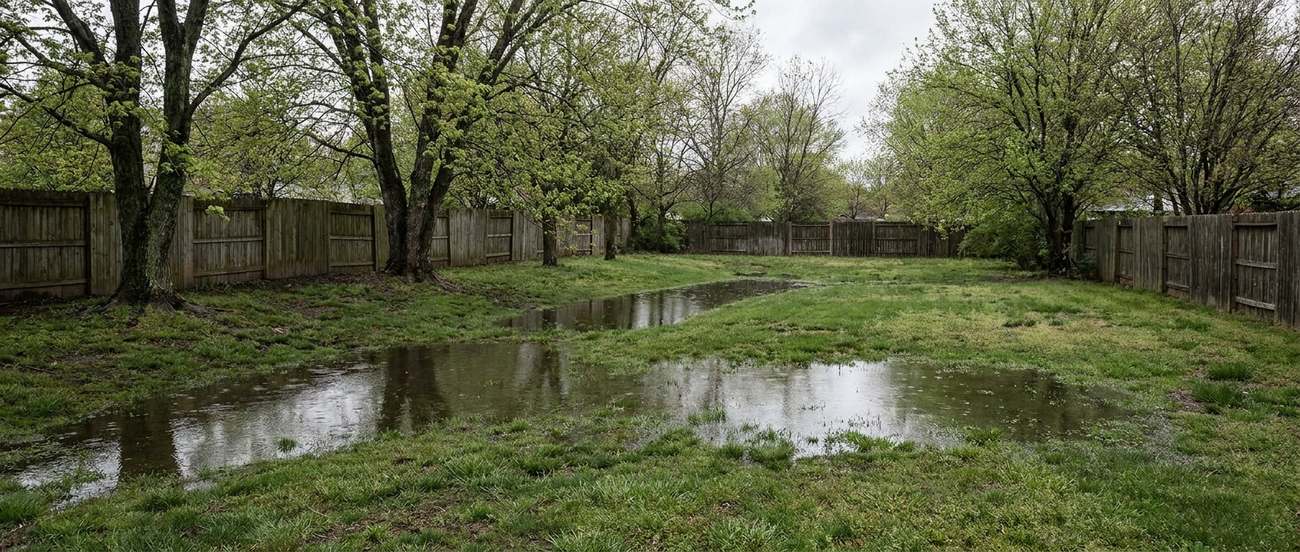
The Triage: Grade First, Pipe Second
- Regrade when the lawn ponds or tilts toward the house — restore positive slope and the problem is cured, not managed. Nothing buried, nothing to clog, mows like a lawn.
- Swales when water must cross your property — a shallow, mowable channel that moves storm flow along the route you choose instead of the one it finds.
- Downspout tie-ins when roof water is the culprit. A single downspout can discharge hundreds of gallons an hour beside your foundation in a Maryland thunderstorm; solid pipe to daylight is the cheapest drainage win in the county.
- French drains where grading cannot reach: foundation perimeters, lot-line squeezes between houses, under driveways. Real tool, right place — roughly $10–$100 per linear foot published nationally, and worth it exactly where dirt cannot do the job.
The Basement Question, Answered Honestly
When the wet basement corner matches the downspout corner outside, the odds are good that exterior grade and roof water are your whole problem — and the fix costs a fraction of interior waterproofing. When water rises through the slab in a dry week, the problem is below grade and a waterproofing contractor is the right call. We tell you which one you have on the first visit, because selling regrades to slab-seepage houses is how contractors earn the reputation this trade suffers from.