New systems, replacements and repairs through the Harford County Health Department process — perc to backfill, with the Critical Area rules and grant money explained up front.
Call (443) 616-2889Failing drainfield, new build, or a lot you are thinking of buying — the right first step is understanding what your soil and your map location require. Call (443) 616-2889.
Bel Air Excavation installs and replaces septic systems throughout Harford County, Maryland. New septic system installation for new construction, septic replacement for failing systems, drainfield replacement, and septic repairs — all through the Harford County Health Department's perc, design and permit process. Conventional septic systems remain legal across most of the county; nitrogen-removing BAT septic systems are required inside the Chesapeake Bay Critical Area, where Bay Restoration Fund grants offset much of the septic upgrade cost. We install septic systems; we do not pump them.
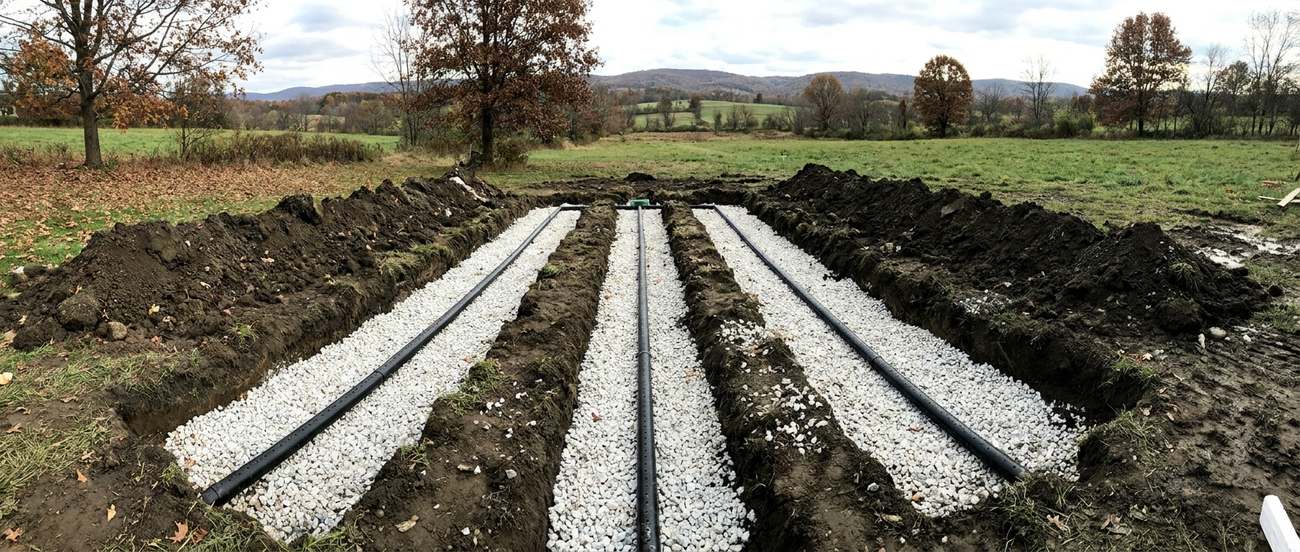
Every septic system in the county runs through the Harford County Health Department's Bureau of Environmental Health. The sequence is fixed: an application, a witnessed percolation test at the proposed drainfield location, a septic system design sized to the house, a permit, and inspections at septic installation. The county even publishes a soil-classification table that rates each soil series for testing — the Glenelg loams common around Bel Air and the northern county are rated testable anytime, while other series are restricted to the wet season so the test sees the soil at its worst. None of this is red tape for its own sake: the perc test is the only thing standing between your drainfield and a failed system in five years.
Harford's split geology shows up nowhere more expensively than septic installation. The Piedmont side — most of the county — percs through loam into weathered schist, and the question is how much usable soil sits above rock. The Coastal Plain side drains through sands fast, sometimes too fast, with seasonal high water tables along the shore communities. Same county, opposite failure modes — and a local septic installer prices and designs for the septic system your parcel can actually carry.
Maryland requires Best Available Technology nitrogen-removal units on new and replacement systems inside the Chesapeake Bay Critical Area — the 1,000 feet nearest tidal water. In Harford County that is the southern shore strip: parts of Edgewood, Joppatowne, Aberdeen and Havre de Grace. Outside it — which is to say, most of the county, including everything around Bel Air, Fallston and the north — conventional systems remain legal; the county repealed its broader BAT mandate in 2017. This one map question changes your project cost by thousands, which is why it is the first thing we check.
Every septic household in Maryland pays into the Bay Restoration Fund; when you upgrade to a nitrogen-removing septic system, the fund pays much of it back. Grants are administered through the county under MDE's FY2026 guidance, sized to income, and prioritized toward failing systems in the Critical Area. If your drainfield is failing, the grant conversation comes before the pricing conversation — full details in the Maryland septic cost guide.
Call about new installs, replacements or a lot you are eyeing. Free consultations, county process handled end to end.
(443) 616-2889First: failing one hole is not failing the property. Perc tests in Harford County are witnessed by the Health Department, and different locations on the same lot perc differently — the county's own soil classification rates some series testable anytime and others only in season. A second location, a different season, or an alternative system design are all standard next steps. What you should not do is buy land without a perc approval and assume it will work out.
Only if you are in the Chesapeake Bay Critical Area — the 1,000 feet closest to tidal waters, which in Harford County means the southern shore strip along Edgewood, Joppatowne, Aberdeen and Havre de Grace. There, Maryland regulation (COMAR 26.04.02) requires Best Available Technology for nitrogen removal on new and replacement systems. Everywhere else in the county, a conventional system is allowed — Harford repealed its broader BAT mandate in 2017. BAT units cost meaningfully more, but the state's Bay Restoration Fund offsets much of the premium for eligible homeowners.
Published national ranges put conventional systems at roughly $3,600–$12,500 installed; BAT nitrogen-removal systems run higher. Where a Harford County job lands depends on soil, system size, access, and whether the county requires BAT at your location. The full arithmetic — including the Bay Restoration Fund grant — is in our Maryland septic cost guide.
Usually, yes. Maryland frost reaches about 30 inches in a cold winter and the machines dig through it without drama; the constraints are Health Department scheduling and whether a perc test is required first (some soils in the county's classification are seasonally restricted for testing). Replacement systems on an existing approval often proceed year-round.
Yes — Maryland's Bay Restoration Fund, funded by the fee every septic household already pays, offsets the cost of upgrading to nitrogen-removing systems. It is administered through the county, grant size is income-based under the state's FY2026 guidance, and failing systems in the Critical Area are the top priority tier. If your system is failing, check the grant before you price anything.
No — installation, replacement and repair are our lane. For routine pumping, Harford County has well-established pumping services; for a system that keeps needing pumped because the drainfield is failing, that is exactly when to call us.